
Denim, Chambray, Cotton, Twill: Untangling Fabric Terms (Chapter 1)

It can feel like you need to take a class just to understand what's in the clothing that you're wearing or buying. To simplify things, there are two primary components of fabrics: composition & weave (from what fibre is the fabric made and how was it made, respectively). Keep reading to learn more and to witness my official confession to a cardinal cotton sin!
Here are some examples of fabric composition:
Cotton
Wool
Linen
Silk
Nylon
Acrylic
Bamboo
Modal
Tencel
Polyester
anything- blend
And here are some examples of fabric weave:
Denim
Chambray
Satin
Corduroy
Twill
Poplin
Voile
Gauze
It all comes down to the what and the how. Another way to think about it is as ingredients vs a recipe. A potato can be baked, mashed, scalloped, fried, wedged, boiled, steamed. Cotton can be woven into denim, chambray, corduroy, gauze, poplin, even satin (though it's usually called "sateen" when it is, just to make things extra confusing!).
Different weaves refer to how the threads are laid out and woven. Denim and chambray are almost always made from cotton, but with the surge of synthetics, the more we need to inspect those garment labels....and on the flipside, while it's technically possible to weave wool or silk into a denim, it would be very unusual and likely labelled as such.
First, woven fabric has strands that run lengthwise and are held taut on the loom (the warp) and strands that are passed over and under the warp strands across the width of the fabric (the weft).
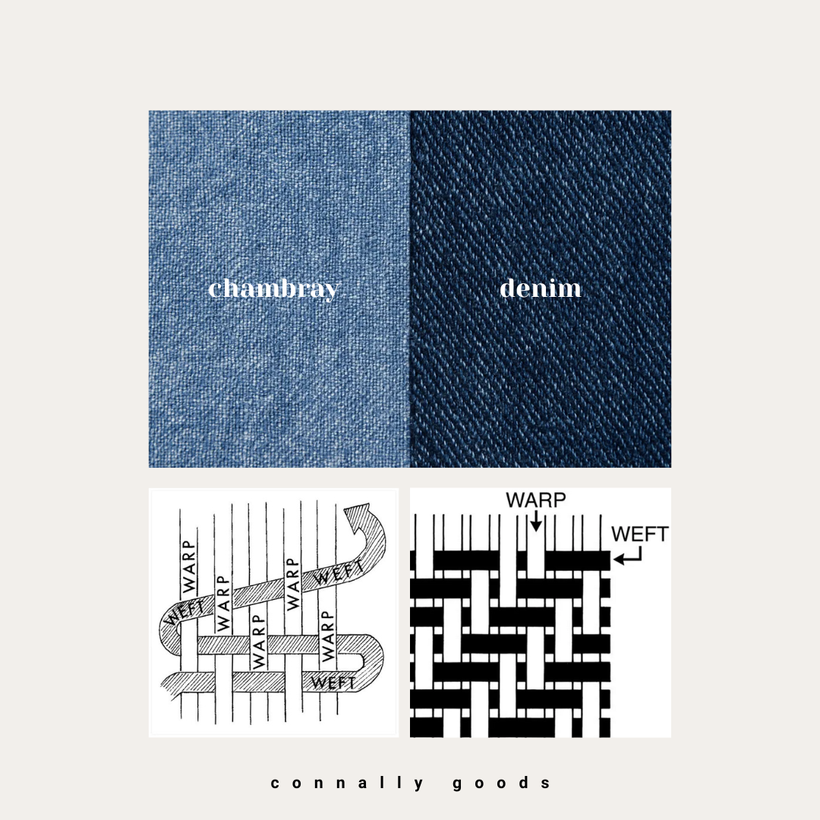
As you can see in the diagram above, chambray is a plain weave, using blue warp threads and white weft threads, while denim also uses blue warp and white weft threads, they utilize a twill weave, forming the appearance of diagonal lines...and those lines serve a purpose!
Besides adding strength and durability to the fabric, denim twill weaving (there are different types of twill weaving, which is for a deeper dive than here) adds depth to the texture, helps resist wrinkling and aids in the fabric's flow while being worn. It's a badass fabric built for function....but what about fashion? Chambray is typically a light blue, the same colour on both sides. It's great for shirting and lightweight dresses, but not quite as hardy as denim, which is typically two-tone from one side to another, and is being produced in colours beyond shades of indigo, but....
Here's where our chambray has a secret, and it was just this morning as I was chatting with Sophie Strauss about her new Denim Handbook (I cannot recommend this book enough, as it goes into all the denim details without getting bogged down in jargon, and is written from a fat-positive, body-neutral perspective...all the things we love!) that I took a pause...because I realised that I'd committed a cardinal sin and not been clear about a fabric that we're currently using, so here's the tea:
The Amy Trousers in Chambray are technically made from 6oz denim. They are chambray coloured. This is straight from the mill and I passed the confusion along. Because chambray (the fabric) is typically pale blue, I went ahead and didn't bother to change the name for our styles in production. Despite priding myself on transparency and providing accurate details so you can make informed decisions, I goofed!
Maybe it wasn't a bad goof, though? At least, that's what I'm telling myself, since it provided an opportunity to explore the topic, and this is just the first of several pieces I'm working on, but let's go back to potatoes. You wouldn't go to the grocery store and buy "I Can't Believe It's Not Potatoes," made from synthesized ingredients intentionally created for brand profit, not nutritional value...so why do we do it with clothes?
Because there's money to be made in confusion. We see it in food and cosmetic commercials all the time, and while there are many labelling laws when it comes to clothes, just as there are with any product that goes in or on our bodies, there's big business to be had if brands can bait & switch or generally use cheaper quality materials and get away with fooling us. Here are two examples of how marketing has been used to pull the (please-don't-let-it-be-synthetic) wool over our eyes:
-
Thread Count. All those bedding brands boasting about thread count? It's because they can't boast about their quality. All "thread count" means is literally how many threads there are in a square inch of fabric...so while yes, in theory, having hundreds of fine cotton threads should be smooth and soft, it often means that manufacturers are using cotton strands more likely to snap, break, fray, just for the sake of boosting those thread count numbers. It's actually much softer to sleep on lower thread count sheets made from higher quality, stronger cotton....and don't get me started on microfibre.
-
Most folks hear "satin" and think "silk," when in reality, the majority of satin that you see in ready-to-wear styles, unless EXPLICITLY stated, will be made from polyester. It goes back to the late 1930's and a DuPont employee discovering they could make fibres by mixing carboxyl acids and alcohols...you know, the usual components in something you want to wear on your skin, the largest organ of the human body. Nowadays it's pretty common to see garments labelled as "silk-like polyester," or "recycled polyester," which are just buzzy rebranding terms used to keep selling us more garbage.
While the DuPont polyester-potato discussion will be continued another day, this experience of forgetting to include pertinent information and potentially causing confusion has been educational (see? I used all my big words in that sentence!). Maybe none of you noticed. Even if that's the case, transparency is important, as is admitting when we've made mistakes.
I'm sure that I'll stumble into many more mistakes in the future, but if you've learned anything from this little side-quest, I hope you'll stick around to explore more together. What threads would you like untangled next? Have you been a victim of unclear labelling?